
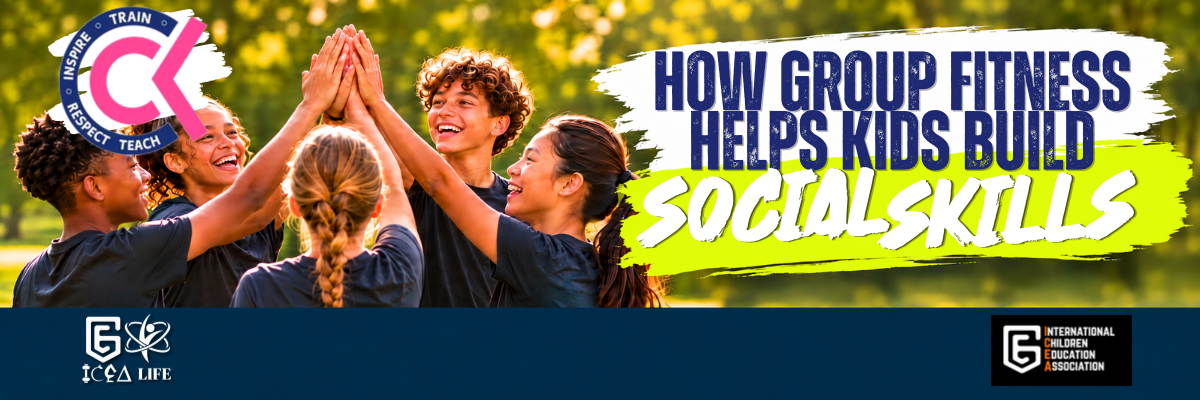
How Group Fitness Helps Kids Build Social Skills
Picture a quiet kid at the end of a relay challenge.
The same kid who barely said a word when they walked in is now yelling a teammate’s name, clapping, jumping up and down as that teammate crosses the line. A teammate they met a week ago.
Then picture their parent at pickup, watching it happen, saying something like, “That’s not my kid. My kid doesn’t do that.”
I have watched some version of that moment more times than I can count over 18 years of coaching. A shy kid finding their voice. A kid who always has to win learning to lose without falling apart. A kid who has never had a real friend walking out of class with one.
And almost none of it happened because we sat them down and taught them social skills. It happened because they moved together.
If you are a parent who worries about how your child gets along with other kids, I want you to know something first. You are not imagining it, and you are not the only one. Many parents tell me their kids seem more anxious around peers, more glued to screens, and less sure how to handle the little moments of everyday friendship: joining a game, taking turns, losing gracefully, sticking up for a friend.
Why Kids Learn Social Skills by Doing, Not Hearing
We tell kids to share, take turns, be kind, and include others. Then we put them in a classroom where they sit quietly all day and expect those skills to show up at recess.
Kids learn social skills the same way they learn to ride a bike. They try it, they wobble, they fall a little, and they try again. They need real moments, with real kids, where something is actually at stake.
That is exactly what group fitness for kids gives them. Every class is full of small social moments that happen naturally while they move:
- ➔Waiting in line for their turn at a station
- ➔Partnering with a kid they don’t know yet
- ➔Counting reps out loud for a teammate
- ➔Losing a race and shaking hands anyway
- ➔Figuring out a team challenge where everyone has a job
None of those feel like a social skills lesson to a child. They feel like a game. But every one of them is practice.
What Group Fitness Teaches That a Lecture Can’t
Here are the skills I see kids build in a good group fitness setting, week after week.
Taking turns and being patient
In a structured class, kids rotate through stations, wait their turn, and watch others go first. At first, some kids hate it. Over time, waiting becomes normal. That patience shows up later at the dinner table, in the car, and on the playground.
Cheering for someone else
This is one of my favorite things to watch. When kids work as a team, they learn that someone else’s success can feel good too.
Winning and losing well
Kids who always need to win often struggle with friendships. In class, they lose a race on Monday and win one on Wednesday. They learn that losing is survivable and that nobody likes a sore winner either. Those are hard lessons to teach at home and much easier to learn in a game.
Communicating with others
Team challenges only work when kids talk to each other. Who goes first? What’s the plan? Can you hold the cone? Even quiet kids start speaking up when the group needs them to.
Handling frustration around others
Every kid gets frustrated. In a group setting, they learn to manage that feeling with people watching, and to keep going instead of storming off. With a coach right there to help them through it, frustration becomes something they can handle instead of something that takes over.
Belonging
This one matters most to me. Many kids walk in feeling like they don’t fit anywhere. After a few weeks of showing up with the same small group, they have people who know their name and expect to see them. That feeling of belonging is the foundation every other social skill is built on.
When a Group Setting Backfires
Here’s the part most people don’t talk about. Not every group activity builds social skills. Some of them do the opposite.
Put a nervous kid in a class of 25 with one coach, and they can disappear. Put a kid who struggles with losing on a team where only the best players get the ball, and they learn that they don’t matter. Put a kid in a program where the coach ignores teasing, and they learn that groups aren’t safe.
In my experience, these are the settings that tend to hurt more than help:
- ➔Groups that are too big. The coach can’t see who is left out, who is being picked on, or who is about to shut down.
- ➔Constant comparison. When every drill ranks kids from best to worst, the kids at the bottom stop trying and the kids at the top stop caring about anyone else.
- ➔No structure. Free play has its place, but kids who struggle socially often get lost when there are no clear roles or rules.
- ➔Coaches who only focus on winning. Kids pick up on what the adult in charge values. If it’s only the score, kindness becomes optional.
A child who has had a bad experience in one of these settings often decides they “aren’t a team person.” Most of the time, they just haven’t found the right team yet.
What to Look for in a Group Fitness Class
If you want a class that builds your child up socially, not just physically, here is what I’d look for:
- ➔Small groups. Six to ten kids is the sweet spot in my experience. Big enough to feel like a team, small enough that nobody gets lost.
- ➔A coach who knows every child’s name. And who notices when someone is sitting out, struggling, or being left out.
- ➔Partner and team challenges. Not just individual drills. Kids need chances to work with each other.
- ➔Clear rules about respect. No teasing, no put downs, and a coach who actually enforces it.
- ➔Effort celebrated over results. The kid who tried hard and finished last should get as much recognition as the kid who finished first.
- ➔The same group week to week. Friendships need repetition. Rotating strangers every class makes it hard to connect.
How We Build Social Skills at Coach Kee’s
Our classes stay small, 6 to 10 kids, and that is on purpose. In a group that size, our coaches know every child. We know who needs a little push to join in, who needs help cooling down after a loss, and who is ready to be a leader.
Every class has a clear rhythm. A greeting, a warm up, a sequence of stations or challenges, and a cool down. When kids know what is coming, they relax. And relaxed kids are much more open to connecting with each other.
We build partner and team work into almost every session. Kids count reps for each other, spot each other on balance work, and solve team challenges where everybody has a role. We mix up partners on purpose so kids get comfortable working with someone new.
We also coach the social moments, not just the physical ones. When a kid celebrates a teammate, we call it out. When someone gets frustrated, we help them name the feeling and get back in. When a kid is left out, we notice, and we fix it.
And because we take a 360 approach, we see the physical, social, and emotional sides of a child as connected. A kid who feels strong in their body tends to feel braver around other kids. A kid who feels like they belong tends to try harder. It all builds on itself.
What About Siblings Who Can’t Get Along?
With the holidays coming up, a lot of parents are bracing for a week of siblings at each other’s throats. I hear it every year.
It’s normal for brothers and sisters to compete for attention, compare themselves to each other, and clash over very different personalities. What helps, in my experience, is giving them chances to be on the same side.
Movement is great for that. A few ideas to try over the break:
- ➔Make them teammates, not opponents. Set up a backyard obstacle course and have them beat the clock together instead of racing each other.
- ➔Give each child a role. One keeps time, one sets up the course, then they switch. Everybody matters.
- ➔Praise them for teamwork. “I love how you two helped each other” goes a long way, and it tells them what you want to see more of.
- ➔Skip the comparisons. “Your brother did it faster” is a fast way to start a fight. Celebrate each child’s own progress.
- ➔Help them name the feeling. When one gets upset, “Are you feeling frustrated because you lost?” helps them calm down faster than “Stop it.”
We see it in class too. Siblings who argue nonstop at home often learn to encourage each other when they’re working toward the same goal.
Signs Your Child Could Use More Social Practice
If your child checks a few of these boxes, a small group fitness class might be a great fit:
- ➔They hang back at parties or the playground and wait to be invited in
- ➔They have a hard time losing a game without a meltdown
- ➔They tend to play alone or stick to one friend only
- ➔They get frustrated quickly when working with other kids
- ➔They light up around other kids but don’t know how to join in
- ➔They spend more time on screens than with friends
- ➔They’ve had a bad experience on a big team and don’t want to try again
None of these mean something is wrong. They just mean your child needs more chances to practice, in a setting that’s built to help them succeed.
Serving Families Across the San Fernando Valley
We offer small group fitness classes for kids in Encino and Tarzana and work with families from Sherman Oaks, Studio City, Woodland Hills, Calabasas, and across the San Fernando Valley. If you’ve been looking for group fitness for kids that builds friendships and confidence, not just muscles, we’d love to meet your family.
We proudly work with both neurotypical and neurodivergent kids, and every class is coached with each child’s needs in mind.
Frequently Asked Questions
Ready to Help Your Child Build Friendships Through Movement?
Every new child starts with a free fitness assessment. We get to know your child, see how they move, talk about their personality and goals, and help you find the right class for them.
Schedule Your Free Assessment No pressure. No commitment. Just a conversation.Strong friendships, like strong bodies, are built one practice at a time.
