
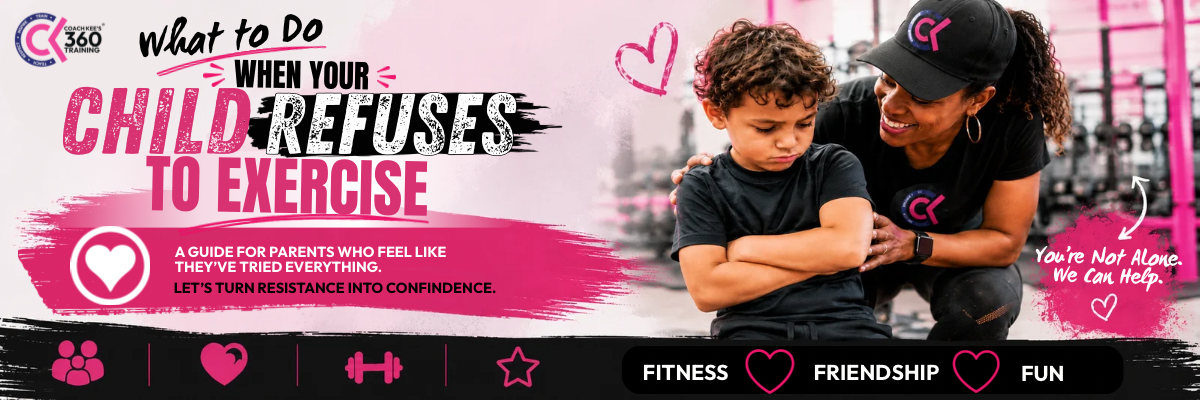
What to Do When Your Child Refuses to Exercise
Every summer starts the same way.
A week of sleeping in. Then the screens come out. And somewhere around week two, you start wondering if your child has permanently fused with the couch.
You suggest going outside. They groan. You mention trying a class or a sport. They have a reason why every single one sounds terrible. You try to motivate them, and it turns into an argument. So you back off. And another day goes by.
If that sounds like your house right now, I want you to know two things.
First, you are not alone. This is one of the most common things parents talk to me about. Second, and this one matters more, the problem is rarely what parents think it is.
That is what I have watched happen for 18 years. And that is what I want to talk about today.
Why Kids Actually Resist Exercise
Here is the thing about kids who refuse to exercise. They seldom refuse movement itself.
The same child who will not go for a walk will spend three hours at a trampoline park without blinking. The same kid who groans at the mention of a fitness class will run around the backyard for an hour if the right friend comes over. They are not avoiding activity. They are avoiding something specific about the way exercise has been presented to them.
And honestly, that makes a lot of sense.
Think about what most kids associate with the word exercise. PE class where they felt slow or uncoordinated. Being picked last for a team. A sport they were pushed into that never felt like theirs. A gym environment where everyone seemed to know what they were doing except them. A coach who noticed the kids who were already good but not the ones who were trying.
If those are a child’s references for what exercise means, of course they are going to resist it. The resistance is not about movement. It is about not wanting to feel that way again.
What Most Parents Try That Makes It Harder
I have heard every version of this conversation from parents over the years. And with the best intentions, most of us land on approaches that quietly make the resistance worse.
Forcing it is the most common one. Getting in the car, we are going, end of discussion. And sometimes that works once. But what it usually does is attach even more negative feelings to exercise. Now it is not just something they did not enjoy; it is something that was done to them.
Bribing creates a different problem. Thirty minutes of exercise and then you get screen time. What that tells a child is that exercise is the unpleasant thing you have to get through before the reward. You are accidentally confirming their belief that it is something to endure.
Signing them up for a team sport because that is just what kids do is something I see a lot. And for some kids, team sports are perfect. But for a lot of kids, especially those who have had bad experiences in group settings, a large team environment is exactly the wrong place to start. Too much noise. Too much comparison. Too little individual attention. They spend more time on the bench than moving and come home feeling worse about themselves than when they left.
Talking about health and fitness in terms of how they look or whether they are staying active enough can also quietly backfire. Kids do not connect those conversations to motivation. They connect them to feeling like something is wrong with them.
None of this is anyone’s fault. These are the tools most of us were given. They just do not work very well.
The Real Difference Between Movement and Exercise
Here is a reframe that I think changes everything for parents.
Your child does not hate movement. They hate what the word exercise has come to mean in their experience.
Movement is natural to kids. It is how they process the world, connect with friends, and feel good in their bodies. The goal is not to make your child someone who exercises. The goal is to help them find a version of movement where they feel capable, seen, and genuinely good at something.
That last part is the key. Feeling good at something.
When a child experiences themselves as capable in a physical setting, something shifts. Not just in how they feel about exercise. In how they feel about themselves. That feeling of I can do hard things, I showed up and got better, I was seen and acknowledged for my effort, that is what creates a kid who actually wants to come back next week.
It is not about making exercise fun in a silly, surface level way. It is about creating the conditions where a child gets to experience real competence. And that requires the right environment, not just the right attitude.
What the Right Environment Actually Looks Like
Most fitness settings are not built for kids who do not love working out. They are built for kids who already do.
That sounds obvious, but think about it. A large class with rotating instructors, minimal individual attention, and a room full of kids at different levels is not where a resistant child is going to discover that they love movement. It is where they are going to confirm every negative belief they already had.
What actually works for kids who resist exercise shares a few things in common.
Small groups where they cannot hide but also cannot get lost. There is a big difference between being invisible in a large class and being seen in a small one. In a group of six to ten kids, a coach actually knows who you are. They notice when you improve. They catch you before frustration turns into shutdown.
Consistency in structure. Kids who resist exercise often resist the unknown more than the activity itself. When a child knows exactly what is coming, the warmup, the sequence, the cooldown, the nervous system settles. They stop bracing for something terrible and start actually participating.
A coach who is paying attention. Not just to the kids who are already thriving, but to the ones who look like they are about to check out. The kids who need the most encouragement are often the ones who give the least obvious signals that they need it.
Progress they can feel. Not trophies or rankings but the genuine internal experience of being better today than they were last week. That is the hook. Once a child feels that, the resistance starts to dissolve on its own.
What a Session Looks Like at Coach Kee’s
Every class in my program has a rhythm to it. Kids know what to expect when they walk in. There is a greeting, a warmup, a structured sequence of movements with clear goals, and a cooldown. Nothing is random. Nothing is chaotic.
Our classes max out at 6 to 10 kids. That is a firm rule and it will never change. In a group that size, every child gets real attention. We know their names, we know what they struggled with last week, and we know what makes them light up and what shuts them down.
The kids who come in most resistant are usually the ones who surprise me the most within the first few days. Not because we did anything magical, but because they finally found a place where they got to feel capable. And once a kid feels that, they stop needing to be convinced to show up.
Signs Your Child Might Be Ready for This
You do not need to wait until the resistance has become a battle. If your child checks any of these boxes, now is a good time to explore something new.
- ➔They have energy to burn but no consistent outlet for it.
- ➔They try activities and quit quickly, usually because they did not feel good at them right away.
- ➔They do better in smaller, calmer environments than in large group settings.
- ➔They talk negatively about being bad at sports or exercise.
- ➔They do noticeably better on days when they have been physically active, but those days are rare.
- ➔They have never found a physical activity that felt like theirs.
These are not signs of a kid who hates movement. These are signs of a kid who has not found the right fit yet.
Summer Is the Best Time to Start
There is something about the summer that makes this easier. The school year pressure is gone. There is no homework, no early mornings, no performance anxiety around grades. Kids are more open in the summer than at almost any other time of year.
It is also when the couch becomes the most tempting competition. Getting a consistent routine established in June and July means going back to school in the fall with something already in place. A child who has been showing up to a structured fitness program all summer goes back to school with more confidence, more energy, and a relationship with movement that carries over into everything else.
Our summer program at Coach Kee’s 360 Training was built exactly for this window. If you have been thinking about trying something new, this is the right time.
Serving Families Across the San Fernando Valley
We work with families in Encino, Tarzana, Sherman Oaks, Studio City, Woodland Hills, Calabasas, and surrounding communities. If you have been searching for kids fitness classes in Encino or anywhere in the San Fernando Valley, we are close and we have availability this summer.
Frequently Asked Questions
Ready to Try Something Different?
If your child has been resisting exercise and nothing you have tried has worked, it is probably not about motivation. It is about finding the right environment. Every new child starts with a free fitness assessment. Not a template. A real plan for your real kid.
Schedule Your Free Assessment No commitment required. Just a conversation.The right environment makes all the difference. Let us find it together.
